
Maine's combination of cold winters, humid summers, and aging housing stock creates an environment where mold can thrive in places you might never think to look. Attics, crawlspaces, basements, behind walls, and around windows — anywhere moisture accumulates without proper ventilation or insulation, mold can take hold and spread.
At Nason's Home Solutions, our IICRC and MICRO certified team handles mold remediation across Central Maine. Here's what homeowners should know about mold, how it gets into your home, and what to do about it.
Why Maine Homes Are Especially Vulnerable
Several factors make Maine homes more susceptible to mold than homes in many other parts of the country:
- Temperature differentials — When it's -10°F outside and 68°F inside, warm indoor air hitting cold surfaces creates condensation. That moisture feeds mold.
- Ice damming — Poor attic ventilation and insulation cause ice dams that trap water under your roof, which can leak into walls and ceilings.
- Older construction — Many Central Maine homes were built before modern building science understood vapor barriers and air sealing. These homes are more prone to moisture intrusion.
- Spring thaw and flooding — Snowmelt and heavy spring rains can overwhelm foundations, especially in homes without proper waterproofing.
- Seasonal occupancy — Camps and seasonal homes that sit closed up for months develop stale, humid air that's a breeding ground for mold.
Common Places Mold Hides
Mold doesn't always show itself in obvious places. The most common locations we find mold in Maine homes include:
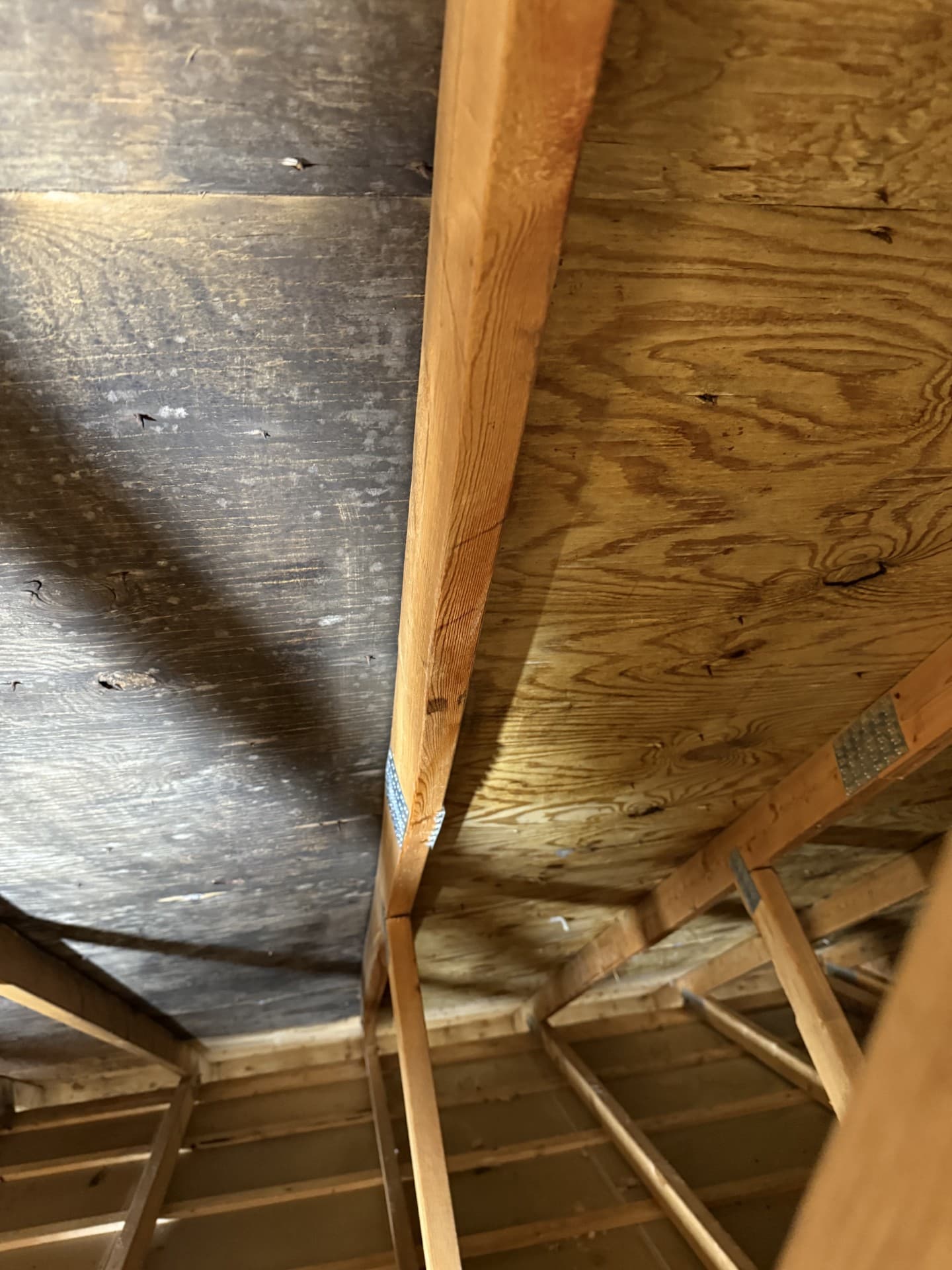
- Attic sheathing — This is one of the most common locations in Maine homes. Warm, moist air from the living space migrates into the attic through gaps and inadequate air sealing, then condenses on the cold roof deck. Over time, the sheathing turns black with mold growth.
- Basement walls and floors — Moisture wicking through concrete, poor drainage, and high humidity create ideal conditions. Finished basements with insulation against foundation walls are especially at risk if moisture wasn't properly managed first.
- Crawlspaces — Exposed dirt floors release constant moisture. Combined with poor ventilation, crawlspaces can become saturated with mold that sends spores directly into your living space.
- Behind bathroom walls — Shower and bath moisture that penetrates walls through gaps in tile, caulk, or grout can feed mold growth you can't see from inside the room.
- Around windows — Condensation on older, poorly insulated windows drips onto sills and into wall cavities. If you see peeling paint or dark spots near your windows, mold may be behind the surface.
Health Effects of Mold Exposure
Mold isn't just a cosmetic issue or a property problem — it's a health concern. The most common health effects of mold exposure include:
- Persistent coughing, sneezing, and nasal congestion
- Eye irritation and watery eyes
- Skin rashes and irritation
- Worsening of asthma symptoms
- Headaches and fatigue
- Respiratory infections in severe cases
Children, elderly individuals, and people with existing respiratory conditions or compromised immune systems are especially vulnerable. If family members are experiencing unexplained allergy-like symptoms that improve when they leave the house, indoor mold could be the cause.
DIY vs. Professional Mold Removal
Small areas of surface mold on non-porous materials — like a bathroom tile or a window sill — can often be cleaned with appropriate products and proper safety precautions. But there are clear situations where professional remediation is necessary:
- The affected area is larger than about 10 square feet — Above that size, EPA points homeowners to its guidance for professional remediation.
- Mold is in your HVAC system — Contaminated ductwork spreads spores throughout your entire home every time the system runs.
- Mold is behind walls, in attics, or in crawlspaces — These require containment protocols to prevent spores from spreading during removal.
- You have health symptoms — If mold is affecting your health, disturbing it without proper containment and personal protection equipment can make things significantly worse.
- The mold keeps coming back — Recurring mold means the underlying moisture source hasn't been addressed. Cleaning the surface without fixing the cause is just temporary.
What EPA Guidance Says About Cleanup
The U.S. Environmental Protection Agency publishes plain-language guidance on mold in homes. A few of its points are often missed:
- The 24–48 hour window — EPA says that if wet or damp materials are dried within 24 to 48 hours of a leak or spill, in most cases mold will not grow. After a burst pipe, a sump failure or a spring-thaw leak, fast drying is the most important step.
- Porous materials may have to go — Mold can grow into the empty spaces of absorbent materials. EPA notes that items like ceiling tiles and carpet may have to be thrown away if they become moldy. Wet drywall and insulation are in the same category.
- Bleach is not the routine answer — EPA does not recommend using a biocide such as chlorine bleach as a routine part of mold cleanup. The goal is to remove the mold and fix the moisture, not just kill what is on the surface.
- Don't paint over it — EPA says not to paint or caulk moldy surfaces. Clean them and dry them first, or the mold keeps growing under the new coating.
- Turn off a contaminated HVAC system — If you know or suspect the heating or air conditioning system has mold in it, EPA advises not running it, because it can spread mold through the whole building.
Do You Need Mold Testing?
Many homeowners assume the first step is a lab test. According to EPA, in most cases where mold growth is visible, sampling is unnecessary. The more useful question is where the moisture is coming from. Testing can still help when you smell mold but cannot find it, or when you need to confirm a cleanup worked, but it is not a substitute for finding and fixing the water.
Find the Water First
In Maine, the moisture behind mold usually comes from a small set of places. Attic mold usually follows warm, humid air leaking up through the ceiling. Basement mold usually follows water coming through the foundation or damp air condensing on cool concrete. EPA recommends keeping indoor humidity below 60 percent, ideally between 30 and 50 percent, which is hard to do over a wet basement or an open-dirt crawlspace.
That is why professional mold removal is only half of the fix. Leaks at the foundation may call for foundation crack repair or basement waterproofing. Attic mold points back to air sealing and insulation, covered in our guide to insulation and air sealing in Maine. A damp crawlspace has its own warning signs, listed in 5 signs your crawlspace is costing you money. The same guidance applies whether your home is in Waterville, Belfast or Ellsworth.
Our Professional Remediation Process
Our mold removal and remediation process covers containment, filtration, removal and the moisture source. Here's what that involves:
- Assessment — We inspect the affected areas, identify the moisture source, and determine the full extent of contamination. Mold often extends well beyond what's visible.
- Containment — We isolate the work area with physical barriers and negative air pressure to prevent spores from spreading to clean areas of your home.
- HEPA filtration — Industrial air scrubbers with HEPA filters run continuously throughout the project, capturing airborne spores down to 0.3 microns.
- Removal and treatment — Contaminated materials are carefully removed and disposed of. Salvageable surfaces are treated with professional-grade antimicrobial solutions.
- Moisture source correction — This is the critical step most DIY approaches miss. We identify and address the conditions that allowed mold to grow — whether that's an insulation deficiency, a ventilation problem, or a water intrusion issue.
- Verification — We confirm the remediation was successful and the environment is safe before completing the project.
Prevention: Stopping Mold Before It Starts
The best mold strategy is prevention. Since mold needs moisture to grow, controlling moisture is the key to keeping your home mold-free:
- Insulate properly — Adequate insulation prevents warm indoor air from reaching cold surfaces where condensation forms. Attic insulation is especially critical in Maine.
- Seal air leaks — Air sealing stops warm, humid indoor air from migrating into wall cavities, attics, and other spaces where it can condense and feed mold.
- Manage basement and crawlspace moisture — Waterproofing and crawlspace encapsulation address the two most common moisture entry points in Maine homes.
- Ensure proper ventilation — Bathrooms, kitchens, and laundry areas need functioning exhaust fans that vent to the outside — not into the attic.
- Monitor humidity — Keep indoor humidity between 30-50%. A simple hygrometer can help you track levels throughout the year.
The Connection Between Energy Efficiency and Mold Prevention
Here's something many homeowners don't realize: the same upgrades that cut your energy bills also prevent mold. Insulation, air sealing, and moisture management are the foundation of both energy efficiency and mold prevention. That's why an energy audit is often the best starting point — it identifies the insulation gaps and air leaks that are both wasting your energy dollars and creating conditions for mold growth.
Insulation and air sealing upgrades may also qualify for Efficiency Maine rebates when they meet the program's requirements, which makes the investment in your home's health and efficiency more affordable.
Serving Central Maine and Beyond
We provide mold remediation and prevention services throughout Central Maine, including Bangor, Hampden, Brewer, Old Town, Ellsworth, Bar Harbor, Belfast, Waterville, and surrounding communities. Whether you need a mold inspection, active remediation, or preventive upgrades to keep mold from becoming a problem, we're here to help.
Questions Homeowners Ask
Can I just spray bleach on mold?
EPA does not recommend bleach or other biocides as a routine part of mold cleanup. The mold still has to be physically removed, and unless the moisture problem is fixed, it will come back.
How big does a mold problem have to be before I call a professional?
EPA says most people can clean an area smaller than about 10 square feet, roughly a 3-foot by 3-foot patch. For larger areas, a lot of water damage, mold inside the HVAC system, or water from sewage or flooding, EPA points you to professional guidance or a professional.
What humidity prevents mold?
EPA recommends keeping indoor relative humidity below 60 percent, ideally between 30 and 50 percent. A hygrometer costs little and shows you where your home stands in each season.
Don't Ignore the Signs
Mold problems don't resolve themselves — they get worse over time. If you've noticed musty odors, visible mold, unexplained health symptoms, or any of the warning signs described above, take action now. Learn about our certifications and team, review our frequently asked questions, or contact us to schedule a free assessment. Call us at (207) 291-6558 — we'll help you understand the problem and find the right solution for your home.