Most homeowners never think about their crawlspace. It's dark, uncomfortable to access, and easy to ignore. But here's the problem: warm air leaving through the top of your house pulls replacement air in from below, and a lot of it comes up through your crawlspace (the stack effect). If that space is damp, moldy, or full of outside air, your home is paying the price — literally.
At Nason's Home Solutions, crawlspace work is a core part of what we do across the Bangor area. Here are five warning signs that your crawlspace is quietly costing you money and affecting your family's comfort.
1. Cold Floors in Winter
If your first-floor rooms have noticeably cold floors from fall through spring, your crawlspace is almost certainly the reason. An uninsulated, vented crawlspace allows frigid Maine air to flow directly under your living space. No amount of turning up the thermostat will fix cold floors if the problem is underneath.
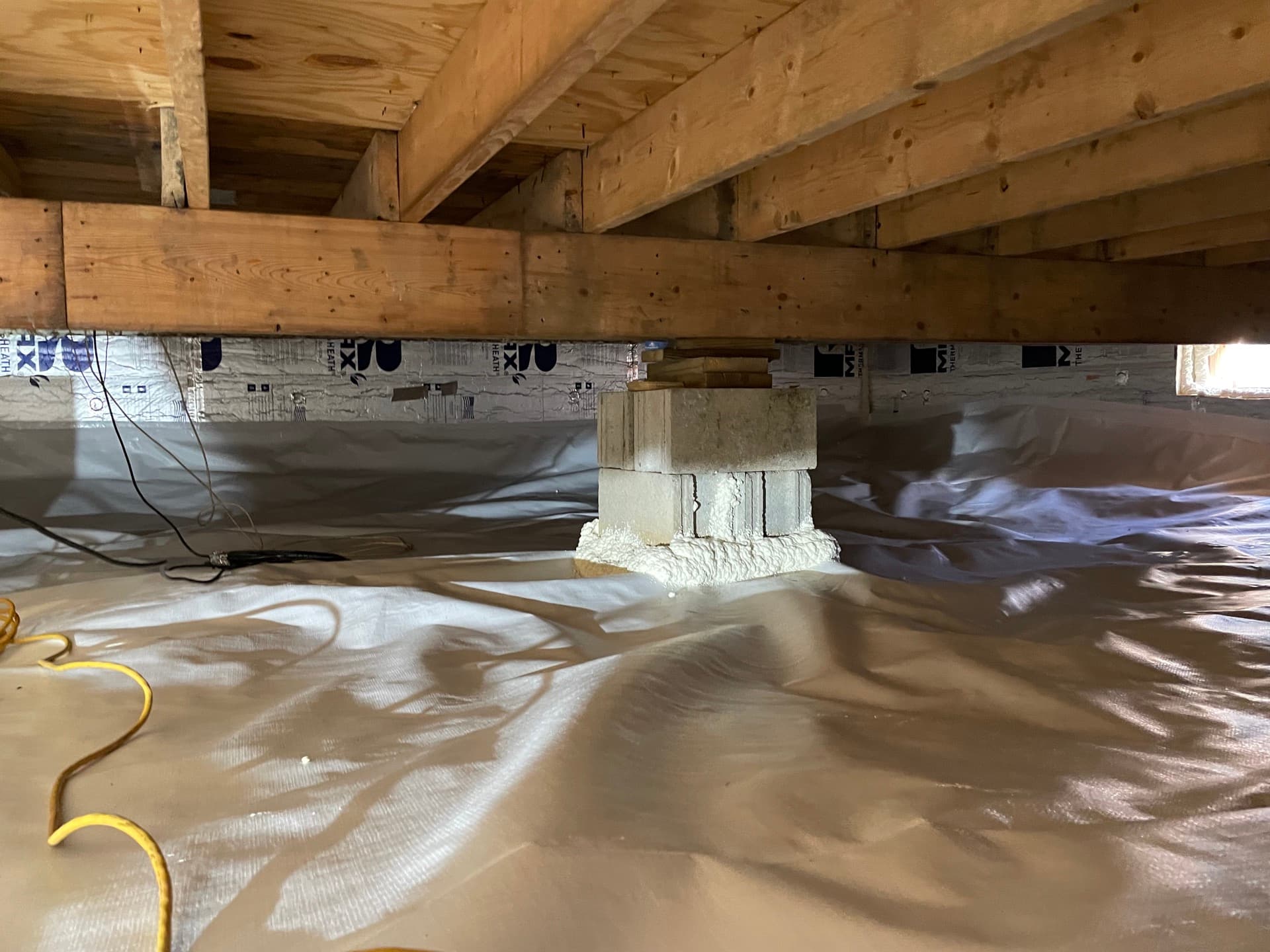
The solution is twofold: sealing the crawlspace from outside air and insulating it properly. Our crawlspace encapsulation process closes off vents, installs a heavy-duty vapor barrier over the floor and walls, and creates a sealed, conditioned space that keeps cold air out and warm air in. The difference in floor temperature is something homeowners notice immediately.
2. Musty or Damp Smell in Your Home
A persistent musty odor on your first floor — especially in closets, hallways, or rooms near the center of the house — is a telltale sign of crawlspace moisture. That smell is caused by mold, mildew, and organic decay happening in the damp space below. Because of the natural stack effect (warm air rises, pulling air up from below), those odors and spores migrate directly into your living space.
If you're already seeing visible mold, either in the crawlspace or on surfaces inside your home, that's an urgent concern. Our IICRC-certified mold removal team can safely eliminate existing mold and address the moisture conditions that caused it. But in most cases, the real fix is stopping moisture at its source through proper encapsulation and dehumidification.
3. High Humidity and Condensation Issues
Do your windows fog up frequently? Do doors swell and stick in summer? Does your home feel muggy even with the AC running? Excess humidity often starts in the crawlspace. An exposed dirt floor releases moisture into the air constantly, and that moisture travels upward through your floor system and into your home.
Encapsulation combined with a properly sized dehumidifier brings crawlspace humidity down to a controlled level — typically 50-55% relative humidity. This not only makes your home more comfortable but also protects your floor joists, subfloor, and insulation from moisture damage. Our waterproofing solutions address any active water intrusion that may be adding to the problem.
4. Pest Problems That Keep Coming Back
Mice, insects, and other pests thrive in damp, dark crawlspaces with easy access to the outside. If you've had recurring pest issues despite repeated treatments, the crawlspace is likely providing a welcome habitat. Open foundation vents, gaps around pipes, and unsealed access doors all serve as entry points.
A fully encapsulated crawlspace eliminates the conditions pests need: moisture, organic material to feed on, and easy access. Sealing vents, installing an airtight door, and covering the floor with a sealed vapor barrier turns your crawlspace from a pest haven into a clean, dry space that's far less attractive to unwanted visitors.
5. Sagging or Bouncy Floors
Floors that feel soft, bouncy, or visibly sag can indicate structural damage to your floor joists — and moisture is usually the culprit. Prolonged exposure to high humidity causes wood to absorb moisture, weaken, and eventually rot. In severe cases, the deterioration can compromise the structural integrity of the floor above.
Addressing this early is critical. Once the moisture problem is solved through encapsulation, damaged joists can be reinforced or replaced. Waiting only allows the damage to spread, making repairs more extensive and expensive.
The Real Cost of Doing Nothing
A neglected crawlspace doesn't just create discomfort — it creates compounding problems. Moisture leads to mold. Mold leads to wood rot. Wood rot leads to structural damage. Meanwhile, your heating and cooling systems work overtime trying to condition air that's constantly being replaced by unconditioned air from below.
A cold, leaky crawlspace makes your heating system work harder all winter. That's real money in Maine, where the heating season runs six months or more. Add in the avoided costs of mold remediation, pest control, and structural repairs, and encapsulation pays for itself relatively quickly.
What Does Crawlspace Encapsulation Involve?
Our encapsulation process follows a systematic approach:
- Inspection and assessment — We evaluate moisture levels, structural condition, existing insulation, and any mold or pest issues.
- Water management — If there's active water intrusion, we install drainage and a sump pump system to manage groundwater before sealing the space.
- Vapor barrier installation — A heavy-duty, reinforced liner covers the entire floor and extends up the foundation walls, creating a continuous moisture barrier.
- Vent sealing — Foundation vents are permanently sealed to prevent outside air and moisture from entering.
- Insulation — Depending on your home's configuration, we insulate the crawlspace walls or the floor above using spray foam for maximum performance.
- Dehumidification — A dehumidifier maintains optimal humidity levels year-round.
Why Vented Crawlspaces Struggle in Maine
Foundation vents were meant to let a crawlspace dry out. In practice they often do the opposite. On a humid summer day, outdoor air flows in through the vents and meets the foundation walls, pipes and ground, which stay cool all year. Building Science Corporation, an independent building research firm, notes that this humid air causes condensation and wetting rather than the drying the vents were meant to provide, and describes traditional vented crawlspaces as often damp, moldy and home to pests. In winter the same vents let frigid air flow under your floors.
That is why current building science favors a closed crawlspace: vents sealed, the ground covered, and the space treated as part of the house.
What a Properly Sealed Crawlspace Needs
- A continuous, sealed ground cover — Building Science Corporation calls for a continuous ground cover of vapor-resistant material with the seams taped. Loose plastic with gaps and open edges still lets ground moisture into the space.
- Insulation on the walls, not the floor above — The same guidance says crawlspaces should be insulated at their perimeter rather than between the floor joists. Perimeter insulation keeps the whole space warmer and drier, including the pipes and ducts that run through it.
- A way to keep the air dry — Once the space is sealed, its air has to be managed, either with a small supply of conditioned air from the house or with a dehumidifier. EPA recommends keeping indoor humidity below 60 percent.
- Water handled first — If water pools on the ground after snowmelt or heavy rain, a liner alone will not fix it. Drainage and a sump pump come before the vapor barrier.
How to Check Your Own Crawlspace
You can learn a lot with a flashlight and an inexpensive hygrometer. Look for standing water or damp soil, white chalky deposits on the foundation walls (a sign of water passing through the concrete), fiberglass batts sagging or falling out of the joists, dark staining on wood, and droppings or nesting material. Leave the hygrometer in the space for a day or two during summer, when humid air causes the most trouble. Readings that regularly stay above 60 percent tell you the space needs attention. The same checks apply whether your home is in Orono, Old Town or Hermon.
One more thing to consider is radon. EPA recommends testing every home and fixing it if levels reach 4 pCi/L or more. Encapsulation is a moisture fix, not a radon system, so test for radon too if your house has never been tested.
The crawlspace is also where cold air enters as warm air escapes through the attic. Our article on insulation and air sealing in Maine explains how the two ends of the house work together, and our guide to mold in Maine homes covers what to do if you find growth down there.
Efficiency Maine Rebates for the Insulation
The insulation part of a crawlspace project may qualify for Efficiency Maine rebates when it meets the program's requirements; the vapor barrier, dehumidifier and vent sealing generally do not. An energy audit helps identify which upgrades will deliver the best return for your specific home.
Serving All of Central Maine
We help homeowners throughout Central Maine tackle crawlspace issues, including Bangor, Hampden, Brewer, Old Town, Orono, Hermon, Holden, Ellsworth, and beyond. Whether your crawlspace needs a basic vapor barrier or a full encapsulation with drainage and dehumidification, we'll assess the situation and recommend the right solution.
Questions Homeowners Ask
Should crawlspace vents be open or closed in Maine?
Closed and sealed, as part of an encapsulation. Open vents pull humid summer air onto cold surfaces, where it condenses, and let frigid air under your floors in winter. Closing vents only works when the ground is covered and the air is kept dry.
Is a plastic sheet on the dirt enough?
Usually not. Building science guidance calls for a continuous ground cover with taped seams. Loose plastic with open edges still lets moisture and soil gases through, and it does nothing about outside air coming in through the vents.
What humidity should a crawlspace stay at?
EPA recommends keeping indoor humidity below 60 percent, ideally between 30 and 50 percent. A sealed crawlspace with a dehumidifier or conditioned air can hold levels in that range year-round.
Get a Free Crawlspace Assessment
If you've noticed any of the warning signs above, don't wait for the problem to get worse. Learn about our team and certifications, or contact us to schedule a free crawlspace inspection. You can also call us directly at (207) 291-6558 — we're happy to answer your questions and help you figure out the best next step.